
Drywall cracks are rarely just a cosmetic nuisance; they are the visual “canaries in the coal mine” for a shifting foundation. Because your home’s interior walls rely on the wooden frame for support, any movement in the crawlspace beneath is instantly telegraphed to the brittle drywall surfaces above.
Maintaining a stable crawlspace foundation is the only permanent way to prevent these cracks from reappearing after you patch them. By ensuring the base of your home remains level and secure, you protect the structural integrity and aesthetic value of your entire living space.
The Physics of Structural Load Distribution
In a crawlspace home, the weight of the roof, walls, and furniture is funneled through the floor joists to the support piers and perimeter footings. If even one of these support points sinks into soft soil, the rigid wooden frame twists, pulling the attached drywall beyond its breaking point.
- Check your floor’s levelness by placing a ball in the center of the room to see if it consistently rolls toward one corner.
- Inspect the crawlspace piers to ensure they aren’t leaning or sinking into the ground, which indicates a localized load-bearing failure.
- Observe the corners of windows and doors, as these are the “stress points” where drywall is most likely to tear when the frame shifts.
When the foundation remains perfectly level, the stress on your interior walls is neutralized, keeping your drywall smooth and crack-free.
Controlling Hydrostatic Pressure and Soil Volume
The soil beneath your crawlspace acts like a sponge, expanding when wet and shrinking during periods of drought. This constant “heaving” and “settling” cycle puts immense mechanical stress on your foundation footings, causing the house to rise and fall in a way that creates recurring drywall fractures.
- Maintain consistent moisture levels around your perimeter with a soaker hose during the dry summer months to prevent soil shrinkage.
- Ensure gutters discharge at least ten feet away from the foundation to prevent soil saturation and “washout” beneath your footers.
- Monitor for plumbing leaks inside the crawlspace, as even a small drip can oversaturate the soil and cause a support pier to sink.
Stabilizing the moisture environment in your crawlspace is the most effective way to stop the “yo-yo” effect that keeps opening up old drywall repairs.
Preventing Wood Rot and Joist Deflection
Crawlspaces are notorious for high humidity, which can lead to wood rot in the very joists and beams that support your subfloor. When these wooden members soften or “sag” due to moisture damage, the walls sitting on top of them drop, leading to horizontal cracks near the ceiling.
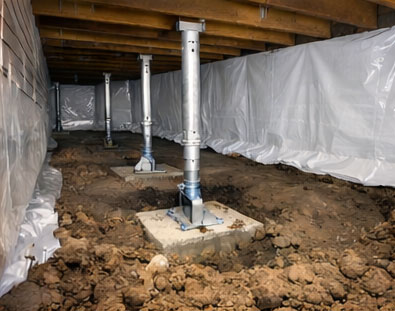
- Install a high-quality vapor barrier that covers 100% of the crawlspace floor to block ground moisture from reaching the wood.
- Inquire about crawlspace encapsulation, which fully seals the area and uses a dehumidifier to keep the air dry and the wood strong.
- Replace any “shimmed” supports that use wood scraps, as these are the first components to rot and compress under the home’s weight.
A dry crawlspace ensures that your wooden support system remains rigid, providing the firm base necessary to keep your interior walls perfectly aligned.
The Role of Support Pier Spacing and Alignment
Over time, the original support piers in a crawlspace can settle or may have been spaced too far apart during initial construction. This lack of adequate mid-span support causes the floor to “bounce” when you walk, creating vibrations that stress the brittle drywall joints throughout the house.
- Verify the spacing of internal piers to ensure they are supporting the long spans of your main load-bearing beams.
- Upgrade to adjustable steel jacks if your current piers are made of stacked cinder blocks, as steel provides more precise and permanent leveling.
- Check for “shimming” failure at the top of the piers, where the wooden frame meets the foundation, to ensure there is no gap.
Properly aligned and spaced piers distribute the home’s weight evenly, eliminating the “flexing” that leads to long-term drywall damage.
Mitigating Thermal Expansion and Contraction
Extreme temperature swings can cause the wooden framing of your home to expand and contract at a different rate than the drywall itself. In an unconditioned crawlspace, these temperature fluctuations are more extreme, leading to “seasonal” cracks that open in winter and close in summer.
- Seal the rim joists and floor penetrations with spray foam to prevent raw, cold air from entering the crawlspace and chilling the subfloor.
- Insulate the crawlspace walls rather than the floor joists to create a “conditioned” buffer zone that stays at a more consistent temperature.
- Watch for “nail pops” in the drywall, which are a sign that the wooden studs are expanding and pushing against the fasteners.
By creating a stable temperature environment in the crawlspace, you reduce the mechanical movement of the wood, protecting the delicate finish of your walls.
Reclaiming Interior Beauty Through Foundation Stability
A stable crawlspace is the invisible anchor that keeps your interior walls looking pristine and your home feeling secure. When you address the root cause of shifting and moisture in the foundation, you eliminate the frustration of constant cosmetic patching and sanding.
Investing in a rock-solid crawlspace foundation ensures that your home remains a source of pride rather than a list of recurring repairs. By securing the base today, you guarantee a smooth, beautiful finish for your living space for decades to come.