
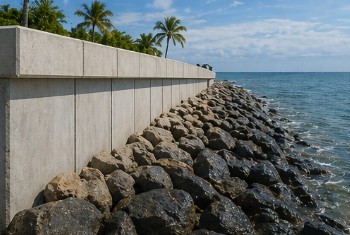
Coastal property ownership comes with the prestigious advantage of oceanfront views, but it also demands a rigorous defense against the relentless power of the tides. A sea wall is not a static ornament; it is a critical engineering barrier that experiences thousands of tons of hydrostatic pressure and salt-driven corrosion every single day.
Ignoring a small crack or a minor “weep hole” clog might seem like a manageable maintenance delay, but in the marine environment, these flaws are early symptoms of structural rot. Left unaddressed, a minor breach allows the ocean to begin an invisible, mechanical disassembly of your land that often ends in total property forfeiture.
The Hidden Danger of Soil Subsidence and Voids
The most common cause of total property loss isn’t the wall falling outward; it is the soil behind the wall washing out through tiny apertures. Known as “piping,” this process occurs when receding tides pull fine sediment through small cracks, creating massive subterranean hollows that can swallow patios, pools, and even house foundations.
- Check for unexplained depressions in your lawn or paver settling near the sea wall cap.
- Monitor for “sinkholes” appearing after heavy rain or high-tide events, which indicate significant soil migration.
- Inspect the water clarity near your wall during a receding tide; murky water is often a sign of your property’s soil being sucked into the ocean.
Once these voids reach a certain size, the surface tension of the remaining soil fails, leading to a sudden and catastrophic collapse of the land you thought was secure.
Hydrostatic Pressure and the “Piston Effect”
Sea walls are designed to withstand the weight of the ocean, but they are often destroyed by the weight of the water trapped behind them. If drainage systems (weep holes) become clogged with barnacles or silt, rain and tide water get trapped in the soil, creating a “piston” of pressure that pushes the wall away from the land.
- Clean weep holes annually to ensure that water can freely exit the soil and equalize the pressure.
- Install specialized filter fabrics behind the wall to allow water through while keeping the sediment in place.
- Look for “leaning” or “bowing” in the wall panels, which suggests the internal pressure has exceeded the wall’s structural capacity.
This internal pressure is the silent killer of coastal barriers, frequently leading to a “blowout” where the entire wall segment detaches and falls into the sea.
Concrete Spalling and Rebar Corrosion
In South Florida and other coastal regions, the salt-heavy air penetrates the porous surface of concrete sea walls, reaching the internal steel reinforcement (rebar). As the steel rusts, it expands up to seven times its original size, cracking the concrete from the inside out—a process known as “spalling.”
- Patch hairline cracks immediately with marine-grade epoxy to prevent salt air from reaching the internal steel.
- Apply high-performance sealants every three to five years to reduce the porosity of the concrete.
- Identify “rust bleeding,” which appears as orange or brown stains on the face of the wall, indicating active internal corrosion.
If the internal steel skeleton of your wall dissolves, the concrete loses its tensile strength and will crumble under the first significant storm surge it encounters.
Toe Scour and Foundation Undermining
The “toe” of the sea wall is the point where the structure enters the seabed; it is the most vulnerable and hardest to see. Wave action can “scour” or scoop out the sand and silt at the base of the wall, eventually leaving the bottom of the wall hanging in open water with no support.
- Conduct underwater inspections every two years to ensure the “mud line” hasn’t dropped below safety levels.
- Install “rip-rap” or large limestone boulders at the base of the wall to break up wave energy and prevent sand loss.
- Watch for “rotation” where the top of the wall tilts toward the land, which often indicates the bottom has kicked out due to lack of support.
Undermining is especially dangerous because it happens out of sight, often remaining undetected until the entire wall suddenly slides vertically into the water.
Catastrophic Failure During Storm Surges
A sea wall with “minor” issues is like a chain with one weak link; it may hold during a calm day, but it will fail precisely when you need it most. During a hurricane or tropical storm, the force of the waves increases exponentially, turning small cracks into major breach points that allow the ocean to flood your entire lot.
- Evaluate your wall’s height relative to rising sea levels and updated local flood maps.
- Reinforce cap-to-panel connections to ensure the entire wall acts as a single, unified unit during a surge.
- Secure tie-backs and anchors, which are the “deadmen” buried in your yard that keep the wall from being pulled out to sea.
A breach during a storm doesn’t just lose you a wall; it allows the ocean to erode the very ground your home sits on, often leading to a total loss of the structure.
Why Proactive Sea Wall Restoration Is A Mandatory Investment
Choosing to ignore sea wall maintenance is effectively choosing to abandon your property to the ocean one tide at a time. The financial cost of a professional restoration is a fraction of the cost of a full replacement, and it is incomparable to the loss of your entire home’s equity.
Protecting your coastal perimeter today is the only way to ensure your property remains an asset rather than a liability. By reinforcing your wall’s integrity now, you secure your piece of the shoreline against the inevitable power of the next great storm.